
Your second floor may seem warmer than other rooms of your house, if it does, you’re having a common problem in multi-story homes. Many homeowners think their AC is broken, but it’s not necessarily so. In most cases, the temperature difference is simply due to the fact that cool air does not readily make it up to the upper level because of several house and HVAC related issues.
The issue can be more prominent in the summertime in the afternoon. A comfortable feel downstairs, while bedrooms and living areas are warm and humid upstairs. The second floor may still have a problem keeping the temperature the same as the first floor even if the AC is on for extended periods of time.
Fortunately, a hot second floor typically has clearly defined causes. Knowing the source of the heat and how the air is being circulated around your air conditioner can help you implement some improvements in order to achieve a more even temperature in your home.
What is the cause of the hot air on the second floor?
Why does the hot air go up to the second floor naturally?
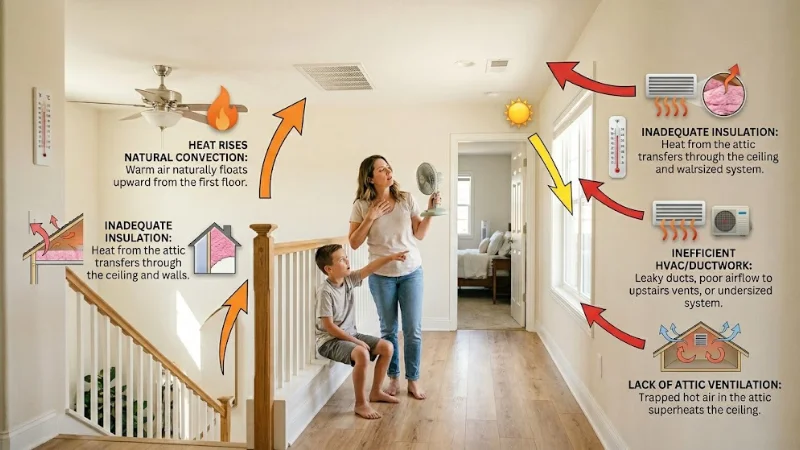
The most frequent cause why your second floor is hot is simple physics. Warm air will rise within the home, as it is lighter than cool air. This warm air is gathered near ceilings and upper levels as temperatures rise during the day, thus the warm air is found in upper levels.
This is a process that occurs in all multi-level houses. Even when the air conditioner is operating well, it is continually trying to overcome the natural flow of heat. This can cause warm rooms to be created faster than warm rooms on the ground floor, so that the first floor rooms typically heat up earlier.
This can be more pronounced the bigger the house. Homes with open staircases, high ceilings or large entry ways can allow warm air to pass more freely between the floors creating more of a temperature difference.
Do rooftops & attics heat up the upper level?
Yes, your roof and attic can raise the temperature up to the 2nd floor. Roofing material during the day absorbs heat from the sun. In the summer, the heat on the roof can be significantly higher than the temperature outside.
That heat is absorbed by the attic. When attic insulation is insufficient or there is inadequate ventilation, the trapped heat starts to impact the rooms below. Bedrooms and hallways on the second floor are usually the first to be affected as they are typically located closest to the attic.
A lot of homeowners consider their air conditioners but forget about the condition of their attics. But, when the attic is not properly insulated, the HVAC system may have to run more to keep the rooms cool and comfortable, and it will be more costly.
Does sunlight make upstairs rooms hotter?
A second source of heat gain in the upstairs areas is exposure to the sun. Large windows bring light into rooms and heat to surfaces like floors, walls, furniture and bedding. After the surfaces absorb heat, they still emit heat to the room.
Rooms that face West and South are generally the ones that have the highest heat gain. The direct sunlight can increase the temperature within the house in the afternoon, even with the air conditioner blowing.
Some of the ways to prevent this build-up of heat include window coverings, energy efficient glass, and exterior shading. If those protections are not in place, then the heat gain from the sun can be among the most significant factors contributing to warmer rooms, one to another, of a house.
Is it possible for HVAC issues to create a hot second floor?
Air flow is essential to your HVAC system to cool each room evenly. The second floor may not get as conditioned air as it requires when air flow is restricted or unbalanced.
In some homes, ductwork was not designed to evenly distribute air to the different floors of a home. Others suffer from airflow issues as the filter gets dirty, the ducts leak, the air vents become blocked or the equipment becomes old.
If cool air doesn’t easily reach upstairs rooms then temperatures start to increase. Even a top-notch air conditioning system can have trouble maintaining the comfort on the second floor when there is poor balance of air flow throughout the system.
Here are some of the usual causes of an upstairs room being hotter
Does bad attic insulation cause my 2nd floor to be hotter?
Yes. Attic insulation is a barrier to the heat that surrounds you and the extreme heat in the attic room. If the insulation is not adequate, heat can penetrate more readily into the lower rooms.
On hot summer days, the temperature in the attic may be an appreciable amount higher than the temperature outside. If there is not adequate insulation, that heat goes up through the ceiling and raises the temperature inside on the second floor.
Insulating or upgrading attic insulation can improve comfort and help to reduce HVAC system work. It can also help to reduce unwanted heat transfer, which can help lower energy consumption.
Does uneven cooling upstairs result from leaky ductwork?
One of the most often forgotten reasons for a hot second floor is leakage in the ductwork. Your ducts are responsible for delivering conditioned air from the HVAC system to each room. When leaks occur, the cooled air leaks out before it reaches its destination.
Ductwork often flows through the attic, crawl space or other unconditioned spaces of many homes. Air that escapes from these areas will not be available in the living spaces to benefit the occupants.
Any leakage, regardless of its size, can cause cooling loss. This loss of conditioned air can cause perceptible differences in temperature between the floors and the upstairs room may be warmer than the bottom room will be.